
Post-War British Theatre
(Routledge, 1976 & in Routledge Revivals, 2015)

(Routledge, 1976 & in Routledge Revivals, 2015)

The definitive account of British theatre from 1945 to the mid-1970s, Elsom traces the seismic shifts that reshaped the stage in the post-war decades. The emergence of the angry young men, the rise of the subsidized regional theatre, the battles over censorship and the abolition of the Lord Chamberlain’s powers with the authority of a critic who lived through the period and reviewed it in real time. Post-War British Theatre is still the standard work on the subject nearly fifty years after its first publication.
Quote By: Name
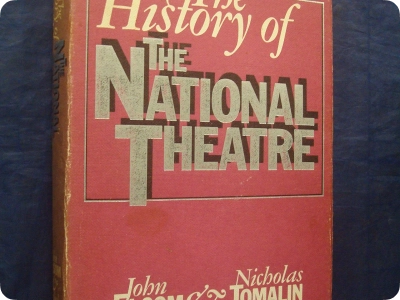
(with Nicholas Tomalin, Cape, 1978)
A comprehensive history of the National Theatre from its origins to its first years at the South Bank written with the journalist Nicholas Tomalin and drawing on unprecedented access to the institution’s records and principals. It talks of the decades of campaigning that preceded the National’s founding, the rivalries, the visions that shaped it, the controversies that attended its early years under Laurence Olivier and Peter Hall.
Quote By: Name

(Secker (UK), 1973, Taplinger (US) 1974 and Dell (US) 1974)
A study of sexuality and the stage not as scandal or titillation, but as a serious critical enquiry into how theatre has always negotiated the boundaries of the permissible. From ancient drama to the liberations of the 1960s, Elsom examines what erotic theatre reveals about the societies that produce and consume it, and why the stage has repeatedly been the place where those boundaries are tested first.
Quote By: Name

(Macmillan, 1971) – a study of the British Repertory movement
A survey of the flourishing regional theatre movement that was transforming British cultural life beyond the capital. At a time when the regions were asserting their identity with new civic theatres and bold programming, Elsom mapped the landscape with characteristic precision and argued for the importance of a genuinely national theatre culture that did not begin and end in London.
Quote By: Name

(Routledge, 1981 & in Routledge Revivals, 2015)
An edited anthology of the best British theatre criticism from the post-war decades, collecting the essential reviews and essays that shaped the conversation about what British theatre was, what it was for, and where it was going. A vital resource for students, scholars, and anyone interested in how criticism and theatre-making developed in dialogue across one of the richest periods in the history of the British stage.
Quote By: Name

(Routledge, 1992 & in Routledge Revivals, 2015)
Between the end of World War II and the fall of the Berlin Wall, theatre on both sides of the Iron Curtain was a battlefield for ideas, national identity, and artistic freedom. John Elsom was uniquely placed to write this account as President of the International Association of Theatre Critics from 1985 to 1992. The result is a vivid, wide-ranging, and deeply personal history of the theatre as a political instrument and a space of resistance.
Author Name

– Routledge, 1989 –
First posed by the critic Jan Kott in 1964, the question of Shakespeare’s contemporary relevance has never been answered but only endlessly reopened. This collection, edited by Elsom and arising from a series of international IATC conferences, gathers responses from directors, critics, and scholars across Europe, Asia, and the Americas. The answers together form a fascinating portrait of how Shakespeare functions as a mirror for each generation’s preoccupations. The book remained in print for twenty years.
Author Name

For nearly two decades, John Elsom was the principal theatre critic and contributing arts editor of The World And I, the Washington-based monthly magazine that brought together writing on culture, science, politics, and the arts for an international readership. His reviews and essays ranged across the major festivals of Europe and America, offering a comparative perspective on world theatre that was rarely found in British publications of the time.
Quote By: Michael Marshall